Heat in the service charge? You are probably a heat supplier
Last checked against Ofgem's published guidance on 30 October 2026. Last updated 30 October 2026. How we check. Not legal advice; see disclaimer and sources.
Probably yes. If your block recovers communal heating costs through the service charge, property-management training says that makes the landlord or management company the heat supplier (unverified against the Regulations by us — source below), and Ofgem’s own reporting guidance tells suppliers with heat “bundled” into rent or service charges how to report it (verified, paragraphs 2.21–2.22). Heat in the service charge does not take a network out of scope; it changes how you report.
Many blocks of flats with a shared boiler don’t bill for heat at all. The gas bill goes into the service charge budget and leaseholders pay their share. That arrangement now sits inside Ofgem’s heat network regulation.
Does heating in the service charge make me a heat supplier?
A heat network is a system supplying heating, cooling or hot water from a central source to more than one end user. The organisation that contracts to supply that heat to consumers is the supplier; the one that runs and maintains the plant is the operator. Property management training now tells block managers that recovering gas costs through the service charge makes the landlord or management company the heat supplier. Unverified against the Regulations by us: this is how The Property Institute’s course describes it. Narrow exemptions exist, for example some houses in multiple occupation; don’t assume one applies to you without checking.
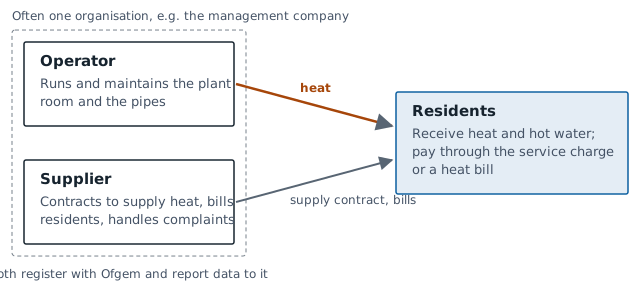
Ofgem’s own reporting guidance takes it as read that some suppliers bundle heat into rent or service charges, and tells them how to report anyway. Verified: regular data reporting guidance, paras 2.21–2.22.
How do I report heating that’s included in the service charge?
The guidance uses “bundled” for heat charges included in wider costs such as rent or service charges. The rules, data point by data point:
- Customers in debt (quarterly): report the number of domestic customers who have met the debt trigger even where the charge is bundled. If some customers are billed separately and some bundled, split the count. Verified: Table 6, p18.
- Standing charges (quarterly): if the standing charge is part of a wider service charge, report only the element relating to the heat network, in pence per day. Verified: Table 8, p22.
- Flat fees (quarterly): same rule, in £ per day. Verified: Table 8, p23.
- Total charges to domestic customers (quarterly) and the 6,000 kWh reference customer (annual): you’ll need the heat element to answer these sensibly. The guidance does not spell out a method. Verified that the data points exist (Table 8, pp23–24); the method is yours to document.
Does the 12-month back-billing limit apply to service charges?
No. Ofgem’s back-billing condition limits bills to heat consumed in the previous 12 months, but it adds that where the charge “is a Service Charge, paragraph 7.1 does not apply”. Verified: Ofgem, authorisation conditions decision, Appendix 2, Condition B7, paragraph 7.3 (page 103).
So for heat recovered through the service charge, the clock in England and Wales is the Landlord and Tenant Act 1985’s section 20B: costs must be demanded within 18 months of being incurred. Ofgem still “encourages” keeping to 12 months. Verified (legal commentary): Devonshires.
If a resident disputes whether a service charge (heat included) is reasonable, the established route in England and Wales is the First-tier Tribunal (Property Chamber). For complaints, Ofgem’s guidance points heat in a service charge to the Housing Ombudsman rather than the Energy Ombudsman; how that works for private blocks is not settled (ombudsman guide). Verified for the Tribunal route (legal commentary): Trowers & Hamlins, Lease Advice. Not legal advice; if a dispute is live, get your own.
Estimates: only where Ofgem says so
Don’t estimate a figure just because the exact one is awkward to pull together. Ofgem says that for each data point its guidance states “whether estimated figures are acceptable to submit” (para 2.19). In Tables 3–8 that’s two: network demand in kWh (“estimates if meter readings are unavailable”) and operating costs (“an accurate estimate is acceptable”). Everywhere else we’d leave an unknown figure blank and flag it as missing rather than guess; that’s our practice, not an Ofgem rule. The checker applies this distinction automatically and tells you which of your figures are allowed to be estimates.
How do I work out the heat element of a service charge?
Ofgem hasn’t published a formula. Whatever you do, write it down and apply it consistently every period, because a change in method looks like a change in price. A defensible approach for a typical block:
- Take the heat-related costs in the service charge budget: fuel (gas or electricity for the plant), plant maintenance and servicing, metering and billing costs, the heat share of insurance, and any repairs fund contribution earmarked for the plant.
- Divide by the number of dwellings, weighted the way the lease apportions the service charge, to get each dwelling’s annual heat element.
- Express it as a daily flat fee (annual ÷ 365) if there is no metering, or as a standing charge plus unit rate if there is.
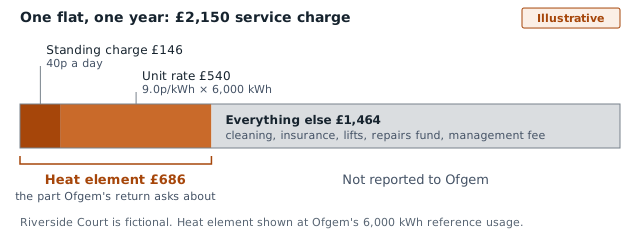
Keep the workings with each quarter’s records. If you’re not sure which costs belong, that’s a question for your accountant or solicitor, not for this site.
Practical consequences
- You’ll need a complaints log that separates heat complaints from general block complaints, using Ofgem’s six categories.
- Service charge arrears: Ofgem says that where charges are bundled “the customer numbers in debt should still be provided” (Table 6, p18), but not how to apply the over-£200, three-month trigger to a bundled charge. Our reading: apply it to the heat element and write the method down. Either way, track the heat element of arrears, not just the total.
- If you use heat meters or heat cost allocators, Ofgem wants the counts annually (Table 4); network demand in kWh is a separate annual figure (Table 8).
The free checker asks whether heat is billed separately, bundled, or both, and flags every data point where you need the heat element before you can report.
Which of these apply to your network?
The free checker gives you the list in three minutes, with a collection template. Nothing leaves your browser unless you ask for the template by email.
Related guides
- Ofgem heat network quarterly reporting: what small networks must submit — The quarterly and annual data points, who reports what, and the windows.
- Communal heating and Ofgem registration: a managing agent's checklist — Registration by 26 January 2027, roles, the Energy Ombudsman, and what to start recording now.
- All 9 guides to Ofgem heat network reporting
What changed on this page
- 30 October 2026
- Corrected: Ofgem's 12-month back-billing limit does not apply to service charges (condition B7.3), so for heat in the service charge section 20B's 18 months is the clock; the old text said both applied. Now verified against Ofgem's own condition. Removed an unsourced line about separating the heat charge on the bill. Estimates: named the two data points where Ofgem allows them. Arrears: marked applying the £200 trigger to the heat element as our reading. Meters: Ofgem asks for counts, not kWh.
- 16 September 2026
- Direct answer added at the top; headings reworded as the questions people ask; roles diagram and service-charge split diagram added; the Property Institute link updated to its new address. No facts, sources or labels changed.
- 16 September 2026
- Added: estimates are only allowed where Ofgem's guidance says so; back-billing section on section 20B, the First-tier Tribunal route and the Energy/Housing Ombudsman overlap, sourced to legal commentary.
- 15 September 2026
- First published, checked against Ofgem's regular data reporting guidance of 10 March 2026.
Spotted an error? Email [email protected] with the page and the source you're looking at — see how we check and correct our guides.